7 min read
Back to Blog
The integration with harbour systems means pilots arrive at the bridge already knowing:
By eliminating the paperwork burden, eMPX gives pilots time back for what actually matters: the conversation with the master.
SeaReady eMPX is designed to run on the same tablet as existing PPU software, allowing pilots to switch between navigation and documentation without carrying additional devices. The two tools work alongside each other—the PPU guides the vessel; the eMPX documents the exchange.
Port Innovation
From Paper to Precision - Why Electronic Master Pilot Exchange is the New Standard
SeaReady Team
Maritime Tech & Consultancy
From Paper to Precision: Why Electronic Master Pilot Exchange is the New Standard
Published by SeaReady Team | 7 min read
1. Introduction: The Critical Handover
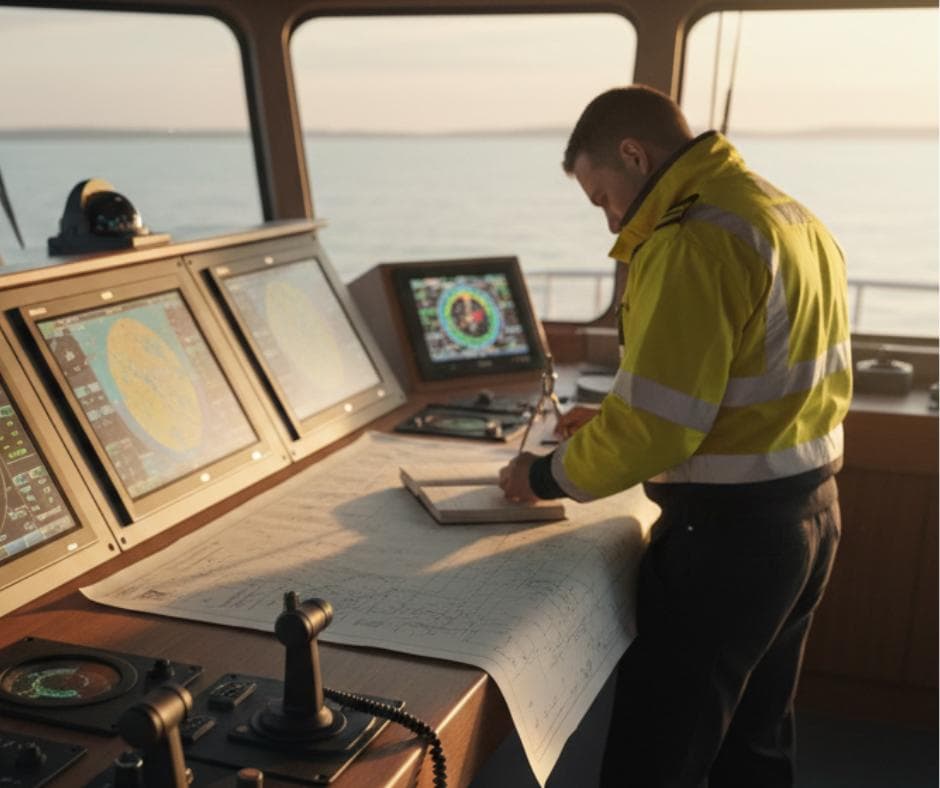
The Master Pilot Exchange (MPX) has long been described as the "missing piece of the passage plan puzzle." For any vessel, the transition between open-sea navigation and the confined manoeuvres of arrival or departure is a high-risk event. Historically, this handover was facilitated by "leather-bag documentation"—a collection of well-creased paper charts, static wheelhouse posters, and manual logs.
However, the maritime industry is undergoing a fundamental shift toward "Proactive Pilotage." This isn't merely a change in medium; it is a strategic transition from reactive, static confirmation to dynamic verification. Electronic Master Pilot Exchange (eMPX) systems are replacing paper to eliminate bridge distractions, mitigate risks of omission, and provide verified data to enhance situational awareness.
2. The Paper Problem: The Reality of Operational Pilotage
The textbook describes the Master-Pilot Exchange as a calm, methodical briefing. The reality is often very different.
The typical pilot's morning: On a cold, dark morning at 0500. You finish one vessel, disembark to the pilot boat, and within minutes you transfer to another vessel. By the time you reach the bridge, the master is already full ahead. The master hands you a crumpled bit of card. You're scribbling vessel details on a bit of paper while simultaneously checking the berth instructions—which changed 20 minutes ago—and trying to confirm the vessel status with the master. The tug is already on station asking for confirmation. The paper MPX form gets sidelined in favour of concentrating on the job at hand.
This is the real problem with paper:
- Last-minute changes: Berth assignments change, tug allocations shift, ETAs slip—but your paper form shows yesterday's plan
- Back-to-back pilotages: No time to properly transcribe vessel particulars when you're boarding straight from another job
- Rushed handovers: Filling in forms on the bridge while the vessel is preparing to move means divided attention at the worst possible time
- Missing information: Realising mid-transit that you never got the vessel's actual draft because there wasn't time to ask
- Lost paperwork: Forms left in pockets, damaged by weather, illegible handwriting
Paper vs eMPX: The Operational Difference
| Scenario | Paper-Based MPX | Electronic MPX (eMPX) |
|---|---|---|
| Berth change 30 mins before arrival | Pilot has outdated information; discovers change on bridge | Auto-synced from PMIS; pilot sees current berth before boarding |
| Back-to-back pilotages | Rush to fill form on bridge; incomplete data | Vessel details pre-populated; review on launch, ready on arrival |
| UKC calculation | Mental arithmetic or calculator while vessel is moving | Calculated automatically with current tidal height |
| Tug assignments | Phone call to confirm; manual note | Already populated from harbour system |
| Post-incident audit | "Where's the form? What did it say?" | Time-stamped, cloud-archived, tamper-proof |
3. The eMPX Edge: Time Saved Where It Matters
The value of eMPX isn't theoretical—it's measured in minutes saved during the most critical phase of pilotage.
Before: 10-15 minutes gathering information, transcribing details, calculating UKC manually.
After: Open the app, review pre-populated data, confirm with master, sign. Under 3 minutes.
Those extra minutes matter:
- Proper briefing: Time to actually discuss the passage plan instead of paperwork
- Earlier departure: Less delay waiting for documentation
- Reduced stress: Pilot focuses on the ship, not admin
- Better communication: Shared screen shows master exactly what the pilot sees
The integration with harbour systems means pilots arrive at the bridge already knowing:
- Current berth assignment (not yesterday's plan)
- Actual tug allocation
- Vessel particulars (no need to transcribe from pilot card)
- Calculated UKC based on real-time tidal predictions
4. Spotlight on SeaReady eMPX: Technical Precision and Forensic Value
The SeaReady eMPX application represents a purpose-built solution designed by pilots, for pilots. Rather than attempting to replicate the functions of a Portable Pilot Unit (PPU), SeaReady eMPX focuses exclusively on streamlining the Master-Pilot Exchange process—complementing existing PPU equipment that pilots already carry.
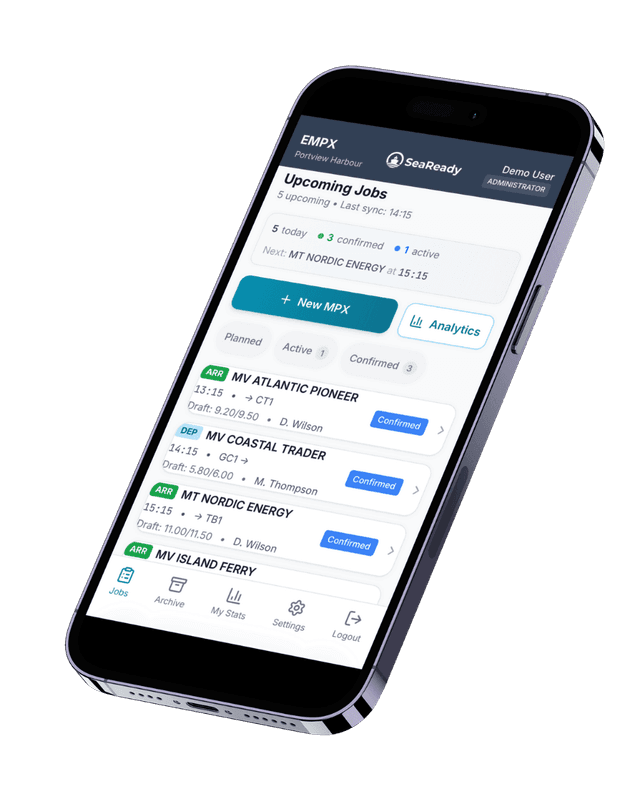
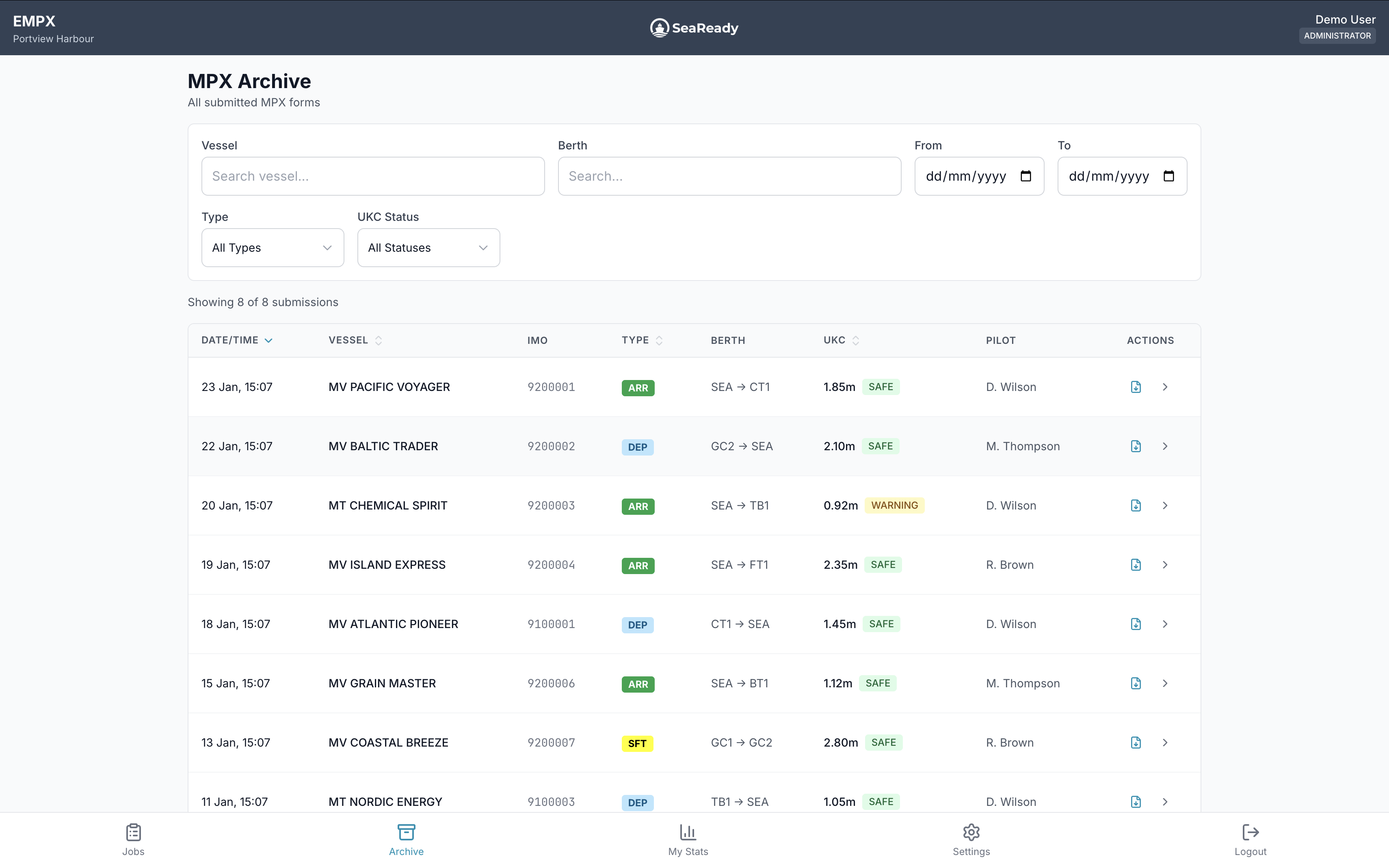
!SeaReady eMPX Dashboard showing real-time vessel and job information
Core Capabilities
- PMIS Auto-Population: Vessel particulars (name, LOA, beam, draft), berth assignments, tug allocations, and timing data flow directly from the harbour's Port Management Information System—eliminating manual transcription errors.
- Automated UKC Calculations: Under Keel Clearance is calculated using chart depths, real-time tidal predictions from the UK Hydrographic Office (UKHO), and squat algorithms. All calculation steps are displayed for pilot verification.
- Safety Guardrails: Configurable minimum UKC thresholds trigger warnings. Pilots must explicitly confirm critical values before form submission.
- Digital Signatures: Both pilot and master sign electronically on the mobile device, creating a legally binding record.
- Cloud Archive: Completed exchanges are securely stored with full audit trails—timestamps, data sources, and calculation parameters preserved for future reference.
- Offline Capability: Operates reliably in maritime 3G/4G conditions with background synchronisation when connectivity returns.
Forensic and Compliance Value
The value of the SeaReady data architecture extends far beyond the immediate transit:
- Incident Investigation: Digital logs provide time-stamped records of all exchanged information. Since April 2023, UK Civil Procedure Rules have mandated the disclosure of Electronic Track Data in collision cases, making eMPX a vital legal safeguard for admiralty courts.
- Port Data Trends: Harbour authorities can track operational patterns and bottleneck trends to improve overall port efficiency and safety protocols.
- Pilot Progression: Data-driven insights allow for the objective monitoring of trainee pilots, providing a feedback loop based on documented exchanges rather than subjective assessment.
IMPA Compliance
SeaReady eMPX meets the core requirements outlined in IMPA Guidance on the Master-Pilot Exchange:
| IMPA Requirement | SeaReady eMPX |
|---|---|
| Vessel particulars (LOA, beam, draft) | ✅ Auto-populated from PMIS |
| Berth/destination information | ✅ Auto-populated from PMIS |
| Pilot boarding arrangements | ✅ Included in job details |
| Tug requirements and arrangements | ✅ Auto-populated from PMIS |
| Under Keel Clearance assessment | ✅ Automated calculation with tidal integration |
| Confirmation of shared understanding | ✅ Dual digital signatures required |
| Record of exchange | ✅ Cloud-archived PDF with audit trail |
5. The Human Factor: Better Briefings, Safer Transits
When pilots are rushing to fill in paperwork, the actual exchange suffers. The conversation becomes a checkbox exercise rather than a genuine safety briefing.
What gets missed when you're writing instead of talking:
- Does the master actually understand the plan?
- Are there concerns about the vessel's handling?
- What's the abort point if something goes wrong?
- Is the bridge team clear on their roles?
By eliminating the paperwork burden, eMPX gives pilots time back for what actually matters: the conversation with the master.
The IMO and IMPA recognize effective information exchange as critical to safe pilotage - yet paper-based systems remain vulnerable to time pressure, illegibility, and lost documentation. The CMA CGM Vasco de Gama grounding at Thorn Channel happened despite two pilots and advanced ECDIS—because the turn plan was never properly briefed.
"The best safety tool isn't technology—it's communication. But you can't communicate properly when you're head-down filling in forms. eMPX handles the paperwork so pilots can focus on the briefing."
6. eMPX and PPU: Complementary Tools
It is important to understand that eMPX and Portable Pilot Units (PPUs) serve distinct but complementary purposes:
| Tool | Primary Function |
|---|---|
| PPU | Real-time navigation, positioning, rate-of-turn, AIS overlay |
| eMPX | Pre-boarding planning, information exchange, documentation, audit trail |
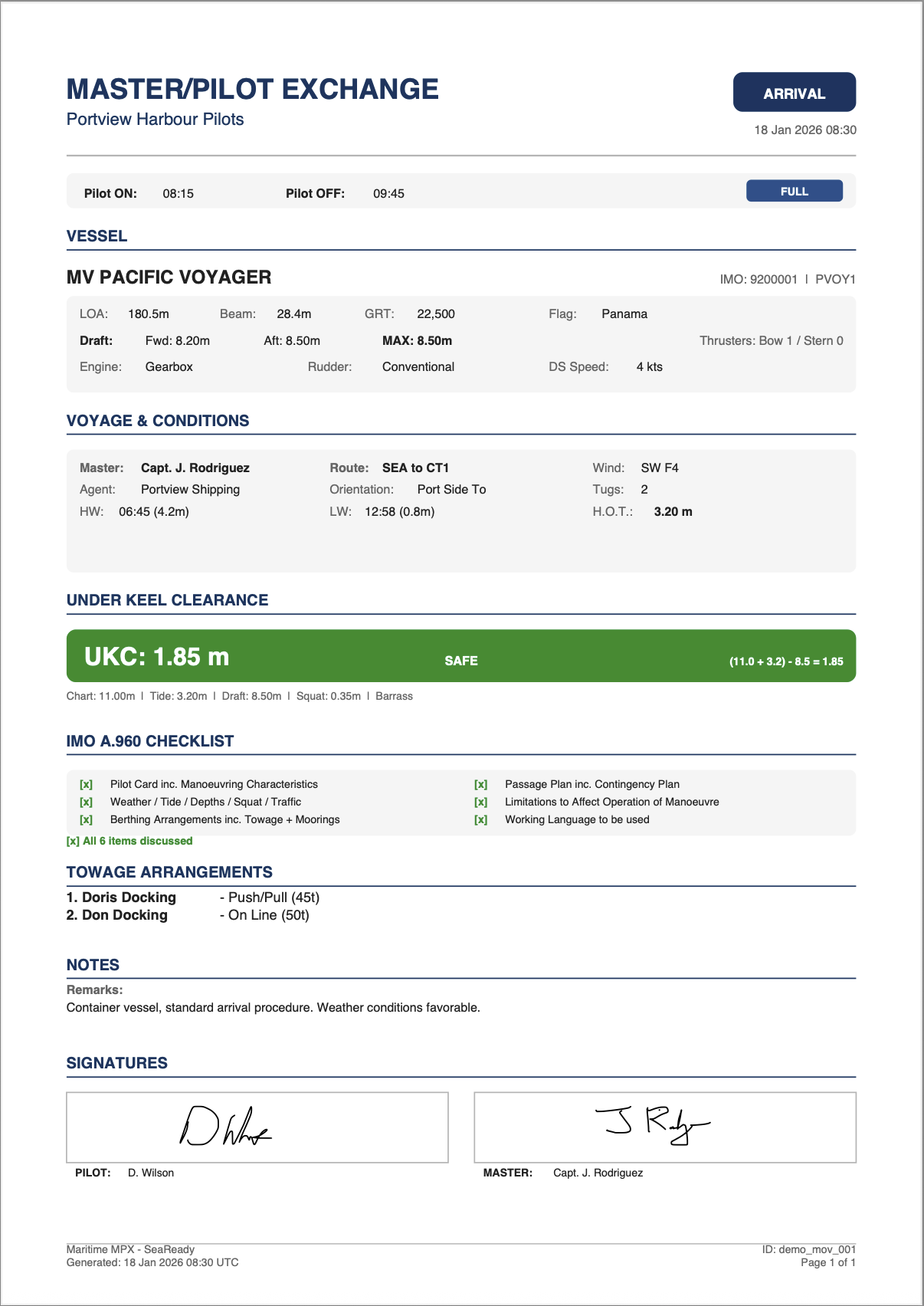
!Digital MPX form with vessel manoeuvring data and signatures
7. Conclusion: Navigating a Digital Future
The transition to eMPX represents a fundamental reconfiguration of the bridge environment. It is no longer acceptable to rely on the "route nobody planned" or the visual-only navigation that led to the Leda Maersk grounding. By adopting digital solutions like SeaReady eMPX, maritime stakeholders embrace a future of precision and transparency.
We are moving toward an era where the Master-Pilot Exchange is not just a meeting, but a continuous, data-driven dialogue that ensures safer, hassle-free voyages for the global fleet.
---
About SeaReady: SeaReady develops maritime software solutions focused on safety, compliance, and operational efficiency. The eMPX application is designed for deployment at ports and harbour authorities worldwide.
For more information, visit seaready.co.uk or contact us to learn how eMPX can enhance your port operations.
Ready to Modernize Your Pilot Operations?
SeaReady eMPX is the digital Master/Pilot Exchange platform designed by pilots, for pilots. Transform your MPX process with a solution that understands your operational reality.

eMPXDigital TransformationMaritime SafetyIMPA ComplianceUKC
About the Author
SeaReady Team
Maritime Tech & Consultancy
The SeaReady team develops maritime software solutions built by mariners, for mariners. Combining decades of seagoing experience with modern technology, we create practical tools that solve real operational challenges in the maritime industry.
Related Articles
Maritime Safety30 Jan 2026
Pilot Ladder Safety - Why the UKMPA's New Interactive Guide Matters
Half of all pilot ladder incidents come down to bad rigging. With SOLAS V/23 amendments coming in 2028, the new UKMPA Interactive Guide shows operators what compliance actually looks like - before PSC inspectors show up with deficiency notices.
Maritime Insights26 Jan 2025
Navigating Workboat Code 3: Your Essential Guide to Mandatory SMS
As of December 2023, WBC3 is now law. The most significant change? Your Safety Management System is now mandatory, with a firm deadline of December 2026 for implementation.